
ThePashto Language

History, Geography & Dialects

A Brief History of Pashto

Pashto is one of the oldest living Eastern Iranian languages, with a literary tradition spanning centuries and tens of millions of speakers worldwide.

~500 BCE – 500 CE

Ancient Roots

Pashto evolves from the Eastern Iranian branch of the Indo-Iranian language family. Its ancestors diverge from other Iranian languages in the mountainous regions between the Hindu Kush and Sulaiman ranges.

8th – 15th Century

Early Literary Traces

The Pata Khazana (Hidden Treasure), a disputed anthology, claims to preserve Pashto poetry from as early as the 8th century. Amir Kror Suri is credited as one of the earliest Pashto poets. Early Pashto religious and Sufi texts begin to appear.

The authenticity of Pata Khazana is debated among scholars.

16th – 17th Century

The Classical Golden Age

Pashto literature flourishes. Bayazid Ansari (Pir Roshan) writes the Khayr al-Bayan, an important religious text. Khushal Khan Khattak, the warrior-poet, becomes a towering literary and national figure. Rahman Baba composes beloved Sufi poetry that remains widely recited today.

Key Figures
Bayazid Ansari (Pir Roshan) (1525–1585)
Religious scholar and writer; authored Khayr al-Bayan; developed an early Pashto alphabet (Roshan script)
Khushal Khan Khattak (1613–1689)
Warrior-poet and tribal chief; wrote extensively on love, war, ethics, and Pashtun identity; considered the national poet of Pashtuns
Rahman Baba (1653–1711)
Sufi mystic poet; beloved for his accessible and deeply spiritual poetry; often called the 'Nightingale of Peshawar'
18th – 19th Century

Expansion and Standardization

Ahmad Shah Durrani founds the Afghan Empire and promotes Pashto as a language of governance. Pashto continues to develop as a literary and administrative language alongside Persian (Dari).

20th Century – Present

Official Status and Modern Era

In 1936, Pashto is declared an official language of Afghanistan by King Zahir Shah. The Pashto Tolana (Pashto Academy) is established in Kabul to standardize grammar, vocabulary, and promote literary works. Pashto media, radio, television, and digital content expand significantly. Today, Pashto is spoken by an estimated 40–60 million people worldwide.

Milestones
1936Pashto declared a national language of Afghanistan
1937Pashto Tolana (Pashto Academy) established in Kabul
1964Afghan constitution reaffirms Pashto as an official language alongside Dari
2004New Afghan constitution maintains Pashto and Dari as the two official languages

Where Pashto Is Spoken

Estimated 40–60 million speakers worldwide

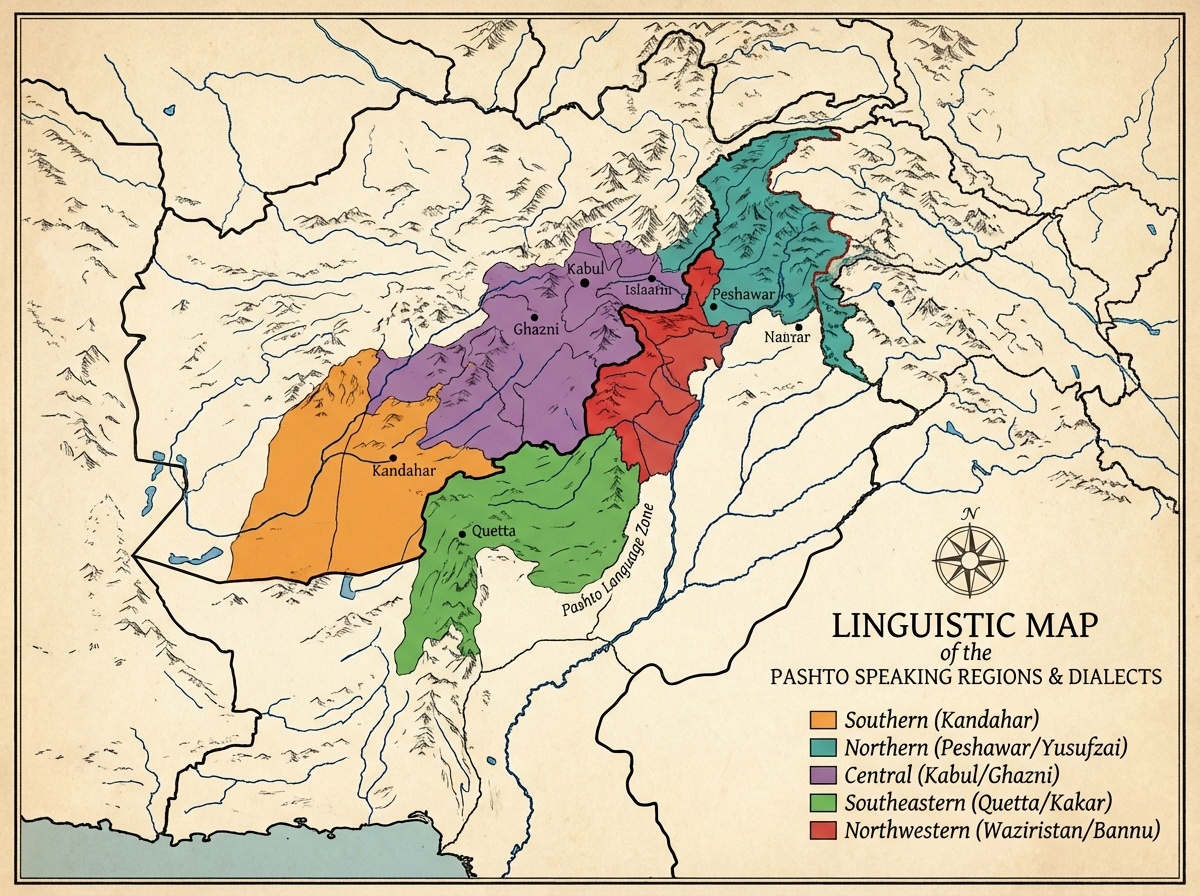
Map showing where Northern and Southern Pashto are spoken in Afghanistan and Pakistan

Afghanistan

Official language (alongside Dari)

~35–50% of the population
KandaharConsidered the cultural heartland of Southern Pashto
Helmand
Nangarhar
Paktia
Paktika
Khost
Zabul
Uruzgan
Ghazni
Kabul (partial)Significant Pashto-speaking population in a multilingual city

Pakistan

Provincial official language in Khyber Pakhtunkhwa

~15% of the national population
Khyber Pakhtunkhwa (KPK)Peshawar is the cultural hub of Northern/Hard Pashto
Former FATA / Tribal DistrictsWaziri and other distinct local dialects
Northern BalochistanQuetta is a major Southern Pashto center in Pakistan
Karachi (urban diaspora)One of the largest Pashtun populations outside the Pashtun belt; various dialects

Diaspora

Minority / heritage language

United Arab EmiratesDubai, Abu Dhabi, Sharjah
Saudi ArabiaRiyadh, Jeddah
United KingdomLondon, Birmingham, Bradford
GermanyHamburg, Munich, Berlin
United StatesNorthern Virginia, New York, California
CanadaToronto, Vancouver
AustraliaSydney, Melbourne

Pashto Dialects

Pashto dialects fall on a spectrum between two major groups — Southern (Soft) and Northern (Hard). The names refer to how certain consonants are pronounced. Despite the differences, speakers across dialects generally understand each other.

Southern / Southwestern Pashto

Also known as: Soft Pashto, Kandahari Pashto

Regions
KandaharHelmandZabulUruzganQuetta (Pakistan)
Pronunciation
  • The letter ښ is pronounced as 'sh' (e.g., the language name is said 'Pashto')
  • The letter ږ is pronounced as 'zh'
  • Generally softer, more sibilant consonant sounds

Retains some older or more classical vocabulary forms. Considered by some to be the more conservative/literary dialect.

Example
زه پښتو زده کوم
Za Pashto zda kawom — “I am learning Pashto

Northern / Northeastern Pashto

Also known as: Hard Pashto, Peshawari Pashto, Yusufzai Pashto

Regions
Peshawar (Pakistan)SwatMardanJalalabad (Afghanistan)Nangarhar
Pronunciation
  • The letter ښ is pronounced as 'kh' (e.g., the language name is said 'Pakhto')
  • The letter ږ is pronounced as 'g' or 'gh'
  • Generally harder, more velar consonant sounds

Some distinct vocabulary items and loanwords influenced by proximity to Hindko and Urdu in Pakistan.

Example
زه پختو زده کوم
Za Pakhto zda kawom — “I am learning Pashto

Transitional Dialects

Waziri
North and South Waziristan (Pakistan)

A distinct dialect with unique phonological features. Falls between the northern and southern groups but has its own identity. The letter ښ may be pronounced as 'xx' (a voiceless velar fricative).

Ghilji / Central
Ghazni, Logar, parts of Paktia (Afghanistan)

A transitional dialect blending features of both northern and southern Pashto. Spoken by the large Ghilji tribal confederation.

Mangal
Parts of Paktia and Khost (Afghanistan)

A southeastern variety with some distinctive local features.

Marwat / Bannuchi
Southern KPK — Lakki Marwat, Bannu (Pakistan)

Southern KPK dialects that share features with both Waziri and northern Pashto.

Dialect Comparison

How key sounds differ across major dialects

FeatureSouthern (Kandahari)Northern (Peshawari)Waziri
Letter ښshkhxx (velar fricative)
Letter ږzhg / ghg / gz
Language namePashtoPakhtoPaxto
Example: 'meat' (غوښه)ghwashaghwakhaghwaxa

The Pashto Script

Pashto is written in a modified version of the Arabic script (Naskh style), with additional letters to represent sounds not found in Arabic or Persian.

Total letters: 44 • Writing direction: Right to left

Pashto has more letters than Arabic (28), Persian (32), and Urdu (39).

Unique Pashto Letters

ټ
retroflex t
Not found in Arabic or Persian
ډ
retroflex d
Not found in Arabic or Persian
ړ
retroflex r
Unique to Pashto
ښ
sh / kh (varies by dialect)
One of the key dialect markers
ږ
zh / g (varies by dialect)
One of the key dialect markers
څ
ts
Not found in Arabic or Persian
ځ
dz
Not found in Arabic or Persian
ڼ
retroflex n
Not found in Arabic or Persian
About This App

Dialects: Peshawari & Kandahari

Khabara supports both Northern (Peshawari) and Southern (Kandahari) Pashto. Use the dialect selector in the dashboard header to switch between them. Most vocabulary is shared across both dialects — only about 40 words differ.

You may still encounter pronunciation differences when speaking with people from different regions — and that's totally normal! Both dialects are widely understood across all Pashto-speaking areas.

The Southern dialect is widely considered the literary standard and is the basis for formal Afghan Pashto. It is broadly understood across Pashto-speaking regions.